Writing
Jev AI judgment models: costs, uses, and the path to AGI
updated 2026-09-17
Jev is an AI model from TypeSafe that turns text and JSON into bounded decisions: a choice, a score, or a yes/no probability. It can help software route work, review answers, and decide when to ask for help. It does not write the answer itself.
That sounds modest. I think it could be a very big deal.
My bet is that cheap, fast judgment is one of the missing pieces on the road to AGI. Agents can produce a lot of work. Someone still has to decide whether that work makes sense. If useful checks become cheap enough to run at every step, we can build more capable systems around the models we already have.
Jev is an early example of that direction. Here is what it offers, what the evidence supports, and what I would test before relying on it.
What is in this guide?
- What Jev does
- Choice, Score, and Noul
- RLCD, probabilities, and confidence
- Prices, speed, and reported tests
- API and Vercel access
- Practical uses and failure modes
- A test plan
- My case for AGI
- Frequently asked questions
What is Jev, and what is a judgment model?
A judgment model evaluates information against a question or set of criteria. The application uses that result to choose its next step. The term describes a role; it does not name one universal architecture.
TypeSafe calls its approach System One. Its September 15 launch describes a specialized architecture, parallel outputs, and training for calibrated decisions. Those are the provider’s descriptions. The public material reviewed for this guide does not provide a complete training recipe or released model weights. TypeSafe launch.
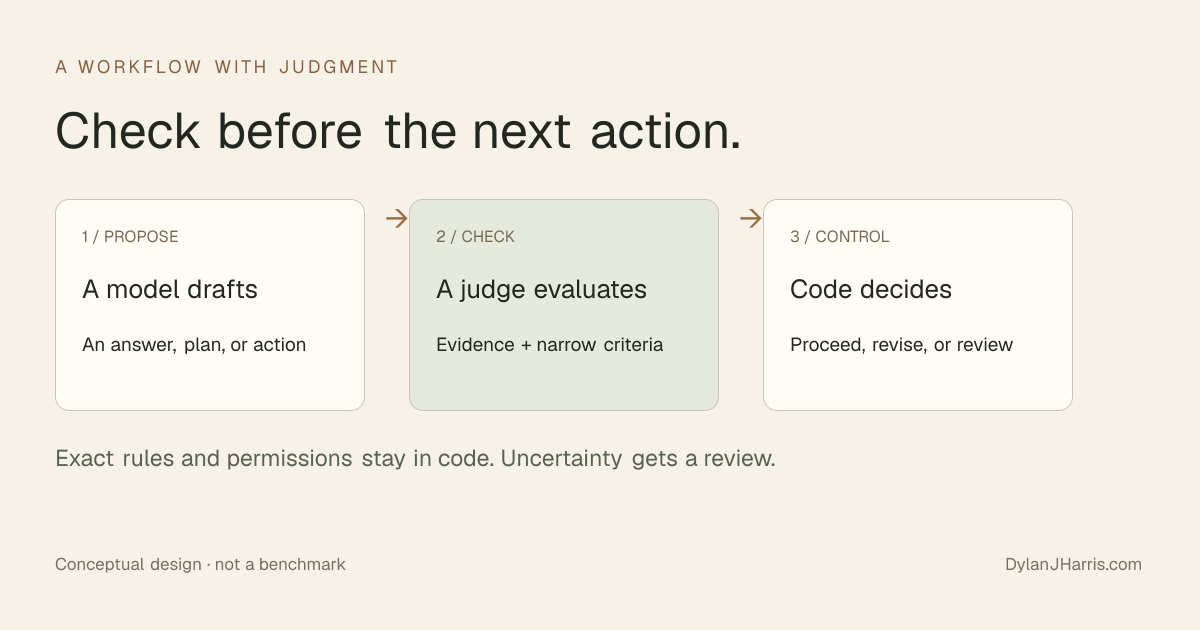
The practical difference is the job you give it. A writing model might draft a customer reply. A judge might evaluate whether that reply answers the customer’s question using the supplied policy. Your program can then send it for revision or review.
Current Jev inputs are text and JSON. It does not directly read images, listen to audio, or watch video. It also does not produce prose explanations. A voice or video workflow would need another component to prepare text or structured state first. System One concepts.
What brought this to my attention?
Nathaniel Whittemore covered Jev in the September 16 AI Daily Brief episode, Why a New Class of AI “Judgment Models” Could Have Big Business Implications. His useful framing was organizational: cheap checks could help work move between people, teams, and agents. Routing, escalation, and review are decisions that appear throughout a business, often between the more visible tasks. Official episode notes, listen on Spotify.
That is what interests me. A system may already know how to write an email or update a record. The harder question is whether it should do that now, with this information, under these rules.
What does Jev return?
The native API has three decision types. You supply the question and allowed answers or criteria.
| Type | Use it for | What comes back | Important limit |
|---|---|---|---|
| Choice | Select a category, route, or next step | A selected option, probability distribution, and confidence | Your options must cover the cases you expect |
| Score | Evaluate against ordered descriptive levels | A weighted score, level distribution, and confidence | It is a judgment on a scale, not an exact measurement |
| Noul | Ask a yes/no question | A probability from 0 to 1 for yes | It has no separate confidence field |
Choice supports up to 255 options. Add an unknown or needs review option when the evidence may not support a clean answer. Score takes 2–10 descriptive levels. Its value is a probability-weighted average of level positions. A score of 1.3 is not a 13% accuracy rate or a count of defects. Choice, Score, Noul.
A small example
Suppose a site assistant drafts this answer:
Yes, we can deliver your order tomorrow.
The supplied store policy only promises dispatch within two business days. A useful review asks three separate questions:
| Question | Type | What the application needs |
|---|---|---|
| Does the policy support the delivery promise? | Noul | A probability that the promise is supported |
| Does the reply answer the customer’s question? | Score | A result against clear levels: unanswered, partial, complete |
| Where should this request go next? | Choice | Reply revision, shipping team, or human review |
This is a proposed design, not a Jev test result. I would expect the unsupported promise to trigger a review, but that expectation belongs in the test set. It is not evidence that the model catches it.
In one native call, questions share the same state and are evaluated independently. A question cannot use another question’s answer from that call. If routing depends on a prior result, combine results in code or make a later call. API introduction.
What is RLCD, and what does confidence mean?
RLCD means Reinforcement Learning for Calibrated Decisions. TypeSafe describes it as training toward useful decisions and probability estimates that match observed outcomes, rather than preferred wording. That is a training objective, not proof that every task is calibrated. TypeSafe’s model primer.
Calibration is easiest to understand across many decisions. For 100 yes/no cases assigned a probability near 0.8, about 80 should actually be yes if those estimates are well calibrated. It does not mean the model has an 80% chance of being right on each case.
This is an established machine-learning problem. Research has shown that strong prediction accuracy can coexist with poor calibration. A model returning a number does not solve it by itself. Guo and colleagues, 2017.
Jev’s separate confidence field is not a correctness probability. For Choice and Score, it describes how concentrated the returned distribution is. A confident model can still select the wrong option. Thresholds must be tested on the decisions your application will make. Confidence reference.
That distinction affects the product design. “Confidence above 0.9” is not enough to justify sending a message, approving a transaction, or publishing a claim. You need evidence about what that threshold does on representative cases.
How much does Jev cost, and how fast is it?
The native model reference lists the following on September 17, 2026:
| Item | Published value |
|---|---|
| Current model ID | jev-1.13.0 |
| Changing aliases | jev-latest, jev-preview |
| Input price | $0.042 per million tokens |
| Output price | No output-token charge |
| Early-access rate limits | 250,000 tokens/second; 1,200 requests/minute |
The limits may change during early access. Pin or record the actual model version when comparing results. Model and price reference.
At that input rate, 100,000 requests averaging 1,000 billable input tokens would cost $4.20 in model input charges. That is arithmetic, not a measured bill. Include the state, questions, retries, and other billable input. Retrieval, other models, hosting, and human review add to the cost.
TypeSafe reports responses in the 70–500 ms range. Its launch also notes favorable network placement and a compact demonstration input. Treat that as a vendor report, not a promise about the response time of your whole application. Launch measurements and caveats.
What do the benchmarks show?
TypeSafe’s published suite covers four workflows: security incidents, agent traces, invoice processing, and customer management. Its reference answers come from other frontier models. Agreement with those references is not independent ground truth. A model can agree with another model and still be wrong. Workflow evaluations.
The provider acknowledges that its team chose the workflows and that asking general models for full probability outputs can add cost and delay. A fair comparison for your product should match the output you actually need. If one category is enough, compare that simpler mode too. Published comparison adapter, launch methodology.
What has someone outside TypeSafe tried?
Mike Taylor reported an editorial experiment at Every with 37 documents and 21 checks per document: 777 judgments. The linked raw record identifies 37 calls, about 612 ms of wall time, and an estimated cost near $0.00265. It dates the run to August 28 and labels the model speed_latest. This is an earlier experiment, not our test of Jev 1.13. Experiment record.
A separate check described in Taylor’s article used 12 constructed passages. Jev found six of seven planted defects; the high-effort comparison model found all seven. Jev was much faster in that small test, but the missed defect matters as much as the speed. Every’s report, updated September 17.
These are useful early experiments. They do not establish reliable authorship detection or performance across a business’s real workload. Editorial patterns can flag a passage for review without telling you who wrote it.
How can you use Jev today?
There are two documented paths:
| Route | Interface | Check before building |
|---|---|---|
| TypeSafe native API | POST https://api.typesafe.ai/v1/systemone with a bearer key | Account access, native question schemas, usage limits |
| Vercel AI Gateway | typesafe-ai/jev through AI SDK evaluation | Compatible SDK version and the experimental evaluation interface |
The native request has a model, shared state, and a named questions object. Put the actual question in its instructions; the question’s key is an application identifier. The response includes answers, model information, and usage. Handle throttling and overload with bounded retries. Native API reference.
Vercel announced support on September 16, with AI SDK 7.0.105 or later and experimental_evaluate. Its adapter calls the yes/no type Boolean, rather than native Noul. The schemas are not interchangeable. Vercel announcement.
Gateway evaluation currently runs through the AI SDK, not its OpenAI-compatible chat endpoint. The evaluation API is experimental and can change in patch releases, so use the current examples and lock your dependency version. Gateway evaluation docs, AI SDK evaluation.
No account access or live model call was tested for this guide. For client material, also check the data settings on your chosen route. A no-training policy and zero retention are different promises. Vercel documents request-level retention controls; do not assume every path has the same defaults. Vercel’s integration and privacy notes.
How is Jev different from an LLM judge or reward model?
Models have evaluated other models for years. Jev does not invent classification or verification. Its proposed benefit is making flexible, typed judgments inexpensive and fast enough to use more often.
| Approach | A useful role | Main tradeoff |
|---|---|---|
| Ordinary code | Totals, dates, permissions, required fields | Exact, but someone must define the rule |
| Task-specific classifier | Repeated decisions with stable categories and labeled data | Needs suitable training data and maintenance |
| LLM as judge | Flexible review, including explanations | Cost, latency, and evaluator bias need measurement |
| Reward model | Rank candidate answers by a learned preference | A preferred answer is not necessarily a correct one |
| Process reward model | Evaluate intermediate reasoning steps | Evidence depends on the task and supervision used |
| Jev-style typed judge | Bounded semantic decisions inside software | No prose rationale; quality still needs testing |
Research on LLM-as-a-judge documents both useful agreement and biases involving answer position, length, and self-preference. RewardBench evaluates learned preference models across several task types. Neither is a test of Jev.
General LLMs can also produce constrained structured output. It would be unfair to compare Jev only with a chatbot that ignores the requested format. Current structured-output documentation and evaluation adapters provide practical alternatives to test.
Where could judgment models help?
These are workflows I would explore. They are design suggestions, not claimed client results.
Support and inbox routing. Give the judge the message, relevant policy, and permitted destinations. Ask whether key information is missing and where the request belongs. Keep account permissions and refund limits in code.
Document-based assistants. Check whether a retrieved passage addresses the question and whether it supports the draft answer. A judge needs the source text. A citation-shaped link alone does not give it evidence. See the website assistant guide for the surrounding retrieval system.
Agent task review. Compare proposed work with the brief before the next tool call. Check whether a change addresses the request or expands beyond its scope. A semantic check can raise a concern; it cannot grant permission.
Technical publishing. Flag repetition, unsupported claims, missing explanations, or a paragraph that fails to answer its heading. Then let an editor or writing model inspect the actual passage. Keep original experience, source context, and attribution intact.
Our current editorial workflow uses these kinds of criteria. We have not validated Jev on this site’s articles, and this article’s publication does not change that.
Work moving between teams. Check whether a proposed commitment needs another owner’s approval before it leaves the organization. This is where fast checks could reduce the small misunderstandings that become expensive later.
The common requirement is a narrow decision with enough evidence to answer it. TypeSafe’s build guide recommends decomposing questions and keeping the surrounding program in control.
What can go wrong?
A valid answer can be the wrong answer. Restricting output to approve, revise, or review prevents an unexpected label. It does not guarantee the correct selection.
TypeSafe documents weaknesses in exact counting, arithmetic, dates, multi-step interpretation, irrelevant context, conflicting criteria, and adversarial instructions. Both context limits apply: 64k tokens for state plus all questions, and 32k for state plus the longest question. A 64k document does not fit just because a headline says 64k. Jev 1.13 known limitations.
Put calculations in code. Supply relevant evidence. Treat external text as untrusted data. Do not use a judgment model as the only permission or security check.
There is also a less obvious risk: optimizing to please the judge. If a writing system learns that the evaluator rewards a certain style, it may produce that style while losing meaning. Research on sycophancy in language models shows why agreement and preference need to be kept separate from truth. It does not show that Jev has solved that problem.
How would I test a judgment model?
I would start with one decision that already costs time. For example: does a draft support reply make a promise that the supplied policy cannot support?
- Write the rule. Define a supported promise, an unsupported promise, and a case that needs more evidence.
- Build a labeled set. Include normal messages, ambiguous wording, missing information, and attempts to steer the judge. Have someone who knows the work review the labels.
- Keep some cases unseen. Use one set to tune questions and thresholds. Use the held-out set to measure the final setup.
- Compare simple alternatives. Try ordinary rules, a structured-output LLM, and Jev with the same evidence and decision policy.
- Measure the errors that matter. A wrong approval and an unnecessary review have different costs.
- Run without taking action first. Log proposed decisions beside the existing process. Inspect disagreements before allowing automatic actions.
- Recheck after changes. Model updates, new policies, and a different customer mix can invalidate old thresholds.
| Measure | Why I would track it |
|---|---|
| Wrong approvals | Work passes when it should not |
| Wrong rejections | Good work is blocked or rewritten |
| Review rate | The system may look accurate by referring almost everything |
| Calibration | Probability estimates should match observed outcomes over groups |
| Median and p95 latency | Typical speed can hide slow cases |
| Total cost and retries | The cheapest model call may not produce the cheapest workflow |
For a future public benchmark, I would also check the provider’s terms first. TypeSafe’s posted customer agreement includes a restriction on publishing customer benchmark results. This guide reports public material and does not claim a new benchmark. Current agreement.
Could judgment models help us reach AGI?
I think cheap judgment could be one of the missing links. That is my view of where this work may lead, not a result established by Jev’s launch.
When I work with agents, the human part of the loop often involves judgment: is this the right problem, did the work meet the request, does that source support the claim, should we stop or try again? Better generation helps. Better selection and correction could change how much work a system can finish on its own.
The exciting possibility is to put useful judgment throughout the process. Check a plan before doing the work. Check a tool result before trusting it. Check an answer before passing it to another agent. Notice when evidence is missing. Change direction before a mistake spreads.
There is research behind parts of this idea. Training Verifiers to Solve Math Word Problems studied selecting candidate solutions with a verifier. Let’s Verify Step by Step found a benefit from supervising intermediate steps in its math setting. Those results do not prove broad AGI, but they show why evaluation inside a process deserves attention.
Price and speed matter because they change where we can afford to check. A review that adds seconds and meaningful cost may happen once at the end. A useful check that takes a fraction of a second could run after many small steps. Whether that makes the system better depends on the quality of those checks.
That is the test I care about: can the whole system complete more useful work, catch more mistakes, and recognize when it needs help? If so, I expect judgment models to have a large positive effect on AI capability. Jev makes that path feel concrete enough to explore.
Does that mean consciousness?
I also wonder whether continuous judgment, memory, and self-correction could contribute to something we would eventually call consciousness. That is a much bigger speculation.
AGI capability and subjective experience are separate questions. A system might do useful work across many domains without having an inner experience. A probability distribution or feedback loop does not settle the question. Current consciousness research proposes theory-based indicators and acknowledges substantial uncertainty; it does not establish cheap judgment as a sufficient test. Butlin and colleagues, consciousness indicators.
So yes, this development makes me excited about the path toward AGI. I want to build with it and see what survives careful testing. I am not claiming Jev is a human brain or that consciousness has arrived.
Frequently asked questions
Is Jev a chatbot?
No. Jev returns structured judgments about supplied text or JSON. Another model or interface would handle the conversation and generated prose. Model concepts.
Is Jev free or open source?
The native hosted service lists paid input usage and free output. The reviewed sources did not provide downloadable model weights. Public SDK or adapter code is not the same as an open-weight model. Pricing, public adapter.
Can Jev make mistakes or hallucinate?
It can make wrong judgments. A schema guarantee controls the form of the result, not its truth. The provider publishes known failure modes. Model limitations.
Can Jev detect AI-written articles?
It can evaluate requested writing patterns. The early editorial experiments do not establish reliable authorship detection. Use the flags to improve clarity and evidence, not to certify a human author. Every’s experiment.
Should every agent action use a judgment model?
No. Use code for exact rules and permissions. Add model judgment where a semantic decision is useful, then measure whether it improves the result enough to justify its errors, cost, and delay.
What is a good first project?
Choose one repeated decision with accessible evidence and a clear reviewer. Test it beside the current process before letting it act. A narrow support-routing or draft-review task is easier to assess than asking a model whether an entire business plan is good.
If you have a workflow in mind, we can work through a small first test together. For the surrounding system design, see how to organize agent work as a graph and how I compare models on a real task.